Why can't I sleep before my period?
Broken nights, trouble falling asleep, or feeling exhausted after eight hours in bed — sleep disturbances are a recognised part of premenstrual syndrome. Here's what's happening in your body and what you can track to get through this time more easily.
In this article
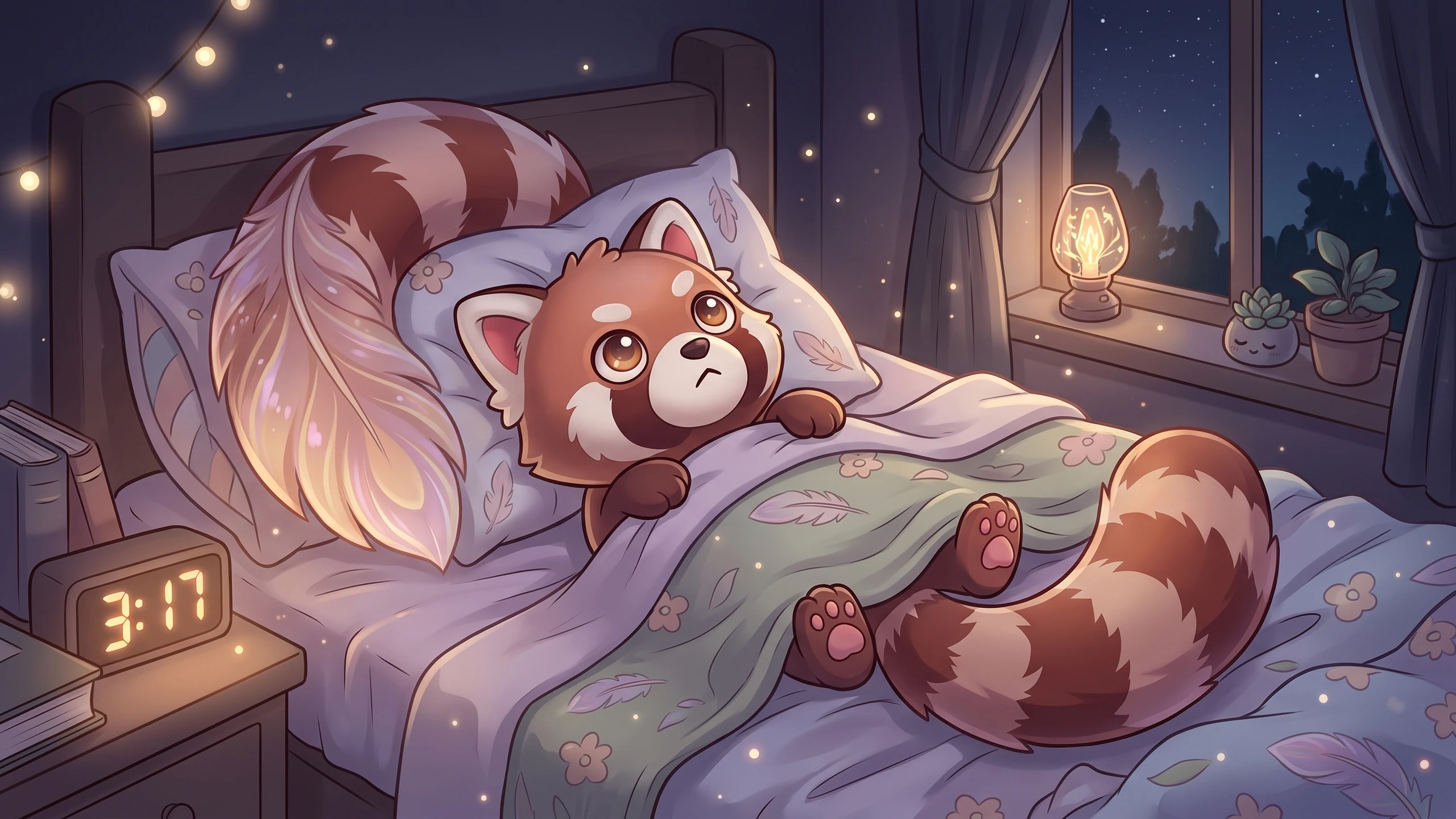
Sleeping poorly in the days before your period isn't a matter of willpower or a passing bout of stress. It's one of the recognised symptoms of premenstrual syndrome (PMS), on the same level as headaches or mood swings. According to the NHS, "tiredness or trouble sleeping" is among the most common PMS symptoms — and it can take several forms: difficulty falling asleep, repeated wake-ups during the night, or on the contrary, excessive daytime sleepiness.
What happens during the luteal phase
The luteal phase is the second half of your cycle, between ovulation and the start of your period. This is when progesterone and oestrogen levels fluctuate most sharply. These hormones have a direct effect on the central nervous system, including how sleep is regulated.
Without getting into overly complex biology: the hormonal shifts of this phase can affect the quality of deep sleep, make it harder to fall asleep, and cause wake-ups in the middle of the night. This isn't a certainty for everyone — some people notice nothing at all, others feel it strongly. Variation from one cycle to the next is also real: a perfect night in November, insomnia in December, with no obvious reason.
The NHS notes that the exact mechanisms behind PMS are not yet fully understood, but that hormonal changes across the menstrual cycle are likely the main cause — and that some people are more sensitive to them than others.
What you can observe in practice
A few pointers to help distinguish cycle-related poor sleep from an unrelated sleep problem:
- Regularity: if the sleep difficulties come back at roughly the same point in each cycle (often 1 to 2 weeks before your period), that's a sign that may point toward PMS.
- Disappearing when your period starts: ameli.fr notes that premenstrual syndrome symptoms disappear once bleeding begins. If your sleep improves from the first days of your period, the cyclical explanation holds up.
- Occurring alongside other symptoms: PMS often involves several signals at once — tender or sore breasts, bloating, irritability or anxiety, headaches. If poor sleep arrives at the same time as these other signs, it strengthens the premenstrual hypothesis.
Keeping a sleep journal over two or three cycles can help you spot this pattern. Plumm lets you log your symptoms throughout your cycle to see whether a regularity emerges.
A few adjustments that may help
The NHS suggests several general approaches for easing PMS symptoms, and some apply directly to sleep:
- Stick to regular sleep times: going to bed and waking up at consistent hours helps stabilise your circadian rhythm, even when hormones are disrupting it.
- Cut back on alcohol and stimulants in the evening: the NHS explicitly advises against alcohol with PMS, partly because it fragments sleep even if it feels relaxing at first.
- Eat little and often: having small amounts every 2 to 3 hours during the day (rather than a heavy evening meal) can reduce the digestive discomfort at night that disrupts sleep.
- Regular physical activity: exercise is recommended by the NHS for PMS symptoms in general. If you already feel drained before your period, our article on exercise fatigue before your period can help you adapt your sessions.
- Yoga or meditation: the NHS cites these as approaches that can help reduce stress, which in turn may make it easier to fall asleep.
These adjustments don't work the same way for everyone and are not a substitute for medical advice if your symptoms are severe.
When to talk to a doctor
If difficult nights before your period are genuinely affecting your daily life — work, concentration, mood — that's the right moment to speak to a healthcare professional. The NHS recommends seeing a doctor when lifestyle changes haven't been enough, or when symptoms are getting in the way of everyday life.
There are more severe forms of PMS, including PMDD (premenstrual dysphoric disorder). Its symptoms resemble those of PMS but are significantly more intense and can include sleep difficulties or marked hypersomnia. If you feel your symptoms go beyond the "standard" picture, bring it up at an appointment — a symptom journal covering two cycles will be very useful to take with you.